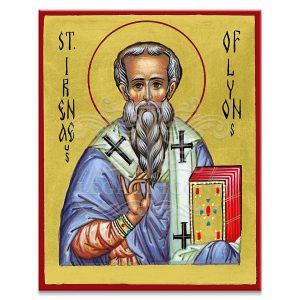
The title of this article might seem bizarre to some readers… because St. Irenaeus isn’t a figure in the Bible. But read on…
I was recently asked to address the question: Where do Catholics find evidence for the office of the Pope? Specifically, the question implied “where in Scripture” do we find the office of the Pope. This article will provide a summary response with regard to Scripture but my primary aim will be to answer this question by taking a wider look at the early church. I wanted to take the opportunity of this question to explain how the early Church Fathers viewed the role of the Bishops and the Pope (the Bishop of Rome) in the first and second centuries… long before we had canonized New Testament Scriptures (The Christian Bible).
It is important to consider this for obvious reasons. Someone living in 180 AD or 225 AD or 300 AD (these are arbitrary, random years for the sake of argument) could not have asked this question because there was not yet a Bible with New Testament Scriptures… but the Church did have Popes during that time. In fact, it wasn’t until the 4th Century that we find the first known list of the 27 New Testament books, as given by St. Athanasius, Bishop of Alexandria. This was compiled in 367 AD. Fifteen years later, in 382, the Church affirmed his list of New Testament Scriptures, as she did again in 393 and 397.
Protestants, who believe in the doctrine of Sola Scriptura (Scripture Alone), reject Sacred Apostolic Tradition as being a source of truth. Catholics, of course, believe in both Sacred Scripture as well as Sacred Apostolic Tradition. But there can be no doubt that there was a Church (and it was called the Catholic Church as early as 110 AD) for over 300 years prior to there being a Bible containing New Testament Scriptures. So on what authority did this early Church base itself if not on canonized Scripture?
For this reason, I’ll look to answer the question not only by Scripture, but also by the writings of St. Irenaeus, who lived in the 100s and wrote a fascinating work called Against Heresies. What is striking about Against Heresies is that some of the heresies Irenaeus is warning against sound very similar to modern day protestantism. Furthermore, to provide a background of St. Irenaeus, he was a student of St. Polycarp who knew the Apostle John. Before we dig into Irenaeus, let’s first summarize what we know from Sacred Scripture about the office of the Pope… and in particular about the Apostle Peter, whom Catholics cite as the first Pope.
Evidence from Scripture
1. Keys to the Kingdom
We’ll start by looking at the Old Testament book of Isaiah. In Isaiah 22, we learn that Eliakim, the son of Hilkiah, was appointed as the royal steward over Israel (the Davidic Kingdom). We read “I will place on his shoulder the key of the house of David; he shall open, and none shall shut; and he shall shut, and none shall open.” This role in the Davidic Kingdom of Israel was like a Prime Minister and he had significant authority.
When Jesus declared that He was the Christ, the everlasting Davidic King, He also appointed His own royal steward: Peter. In Matthew 16:19, Jesus tells Peter, “I will give you the keys to the Kingdom of Heaven, and whatever you bind on earth shall be bound in heaven, and whatever you loose on earth shall be loosed in Heaven.”
These parallel passages (Isaiah 22 and Matthew 16) are not a grammatical or linguistic coincidence. Matthew, whose Gospel is the most “Jewish” of all the Gospels and points to the fulfillment of the Davidic Kingdom in Jesus, is intentionally making the connection to Eliakim with regard to Peter’s new role in the new and everlasting Kingdom. As Peter’s position of authority is derived from Eliakim’s position, it becomes clear that Peter – and his successors – hold a special place in the Church.
2. The Rock
Just before appointing him as His royal steward, Jesus gave Simon the new name of Peter. It was a name that has no record of use prior to the Apostle Peter. In renaming Simon, Jesus said “I tell you, you are Peter, and on this rock I will build my Church, and the gates of Hades shall not prevail against it” (Matthew 16:18). Immediately afterward, he gives Peter the Keys to the Kingdom.
Is there a significance to the name Peter? The English name, Peter, comes to us from the Greek “Petros,” a masculine noun meaning “rock” or “stone.”
You are Petros, and on this rock I will build my Church…
The Greek word translated as “rock” that comes later in the verse (“and on this rock I will build my Church”) is “petra” and it has been said to refer to a “massive boulder.” So to use the Greek for both words, we could say:
Thou art Petros and on this petra I will build my Church…
Some protestants have pointed out the difference in word choices for “rock” (Petros and petra) and have suggested that Peter is not the rock upon which the Church was built.
This difference in words, however, appears only in the Greek and this difference is not found in the original language in which Jesus spoke… nor in the original language in which the Gospel of Matthew was possibly written.
St. Papias and St. Irenaeus allude to the Gospel of Matthew being originally written in Aramaic, not Koine Greek… and, regardless, Jesus would have originally spoken His words quoted in Matthew 16 in Aramaic. The only Aramaic word for rock would have been “kepha.” So to use the original Aramaic for both words, we’d read:
You are Kepha, and on this kepha I will build my Church…
In case you’re interested, the reason that the Greek differentiates “Petros” and “petra” is because “petra” is a feminine noun in the Greek and it would be improper to refer to a male, Peter, with a feminine noun. “Petros,” is the masculine noun.
I go over all of this so it’s clear to my readers that Matthew (and therefore, Jesus) was clearly teaching us that Peter himself was the rock upon which Jesus’ Church would be built. He built His Church upon Peter… appointed him as royal steward, and gave him the Keys to the Kingdom of Heaven – and that role entailed, as I mentioned above, significant authority.
Furthermore, the early Church recognized Peter as the rock upon which Jesus established His Church. Here are just a few of many examples:
- Tatian the Syrian (170 AD): In The Diatesseron 23, Tatian acknowledged Peter as the rock upon which the Church was built.
- Tertullian (200 AD): In Demurrer Against the Heretics 22, Tertullian writes, “Peter, who is called ‘the rock on which the Church would be built’ with the power of ‘loosing and binding in heaven and on earth.’”
- Origen (248 AD): In Homilies on Exodus 5:4, Origen writes “Look at [Peter], the great foundation of the Church, that most solid of rocks, upon whom Christ built the Church.”
- Cyprian of Carthage (251 AD): In The Unity of the Catholic Church 4, Cyprian writes, “Indeed, the others were that also which Peter was [that is, apostles], but a primacy is given to Peter, whereby it is made clear that there is but one Church and one chair. . . If someone does not hold fast to this unity of Peter, can he imagine that he still holds the faith? If he [should] desert the chair of Peter upon whom the Church was built, can he still be confident that he is in the Church?”
3. “Protos” / Peter Listed First
We know from reading, comparing, and reconciling passages in Matthew 16 and John 1 that Andrew (Peter’s brother) answered the call to follow Christ before Peter did. But in Matthew 10:2-4, we read the list of the twelve apostles. He begins with, “The names of the twelve apostles are these: first, Simon, who is called Peter” and then continues to name the remainder of the apostles of Christ. The Greek word “protos,” translated as “first” in Matthew 10 can mean “first chronologically” but it can also mean “first and foremost” or “the most prominent.” Since we know that Peter was not chronologically first, we can be sure that Matthew’s intended use of “protos” was to identify Peter as the leader of the apostles.
Furthermore, one can clearly see the Gospel writers’ understanding that Peter was indeed the chief apostle. In all New Testament lists of apostles, Peter’s name appears first. At times, there isn’t even a “list” – it’s just “Peter and the twelve.” Additionally, Peter’s name is mentioned more often than all of the names of all other apostles combined.
4. Peter’s Leadership
In John 21, the resurrected Jesus commands Peter to take care of His flock. Peter was singled out by Christ, entrusting him with this responsibility. Previously, as conveyed in Luke 22, Jesus told Peter that he (Peter) would deny Him (Jesus) before His death on the Cross, but that he (Peter) would then turn back to Christ. Jesus instructed Peter that once he has turned back, he (Peter) is to “strengthen your brothers.” We also know that the resurrected Jesus appeared to Peter before appearing to the rest of the apostles (Luke 24:34; 1 Cor 15:3-8).
As the Church took shape, we read about Peter’s leadership in the Book of Acts. In Acts 1, Peter heads the meeting where a new apostle, Matthias, is appointed. In Acts 2, Peter leads the Apostles in preaching on the Day of Pentecost. In Acts 5, we read that Peter was the judge of Ananias and Saphira. In Acts 15, Peter leads the first council in Church history – a meeting to discuss how they were to handle matters with Gentiles in the Church.
Evidence from the Early Church
Irenaeus and Against Heresies
Now let’s move on to discuss the early church and what we know outside of Sacred Scripture. What we will find is that Sacred Tradition agrees with the Catholic understanding from Scripture – that Peter was the chief Apostle. In examining the early church, we’ll look at St. Irenaeus and portions of his work entitled, Against Heresies. Remember… Irenaeus was a student of Polycarp, who knew the Apostle John. He’s writing in the 100s to caution Christians against heresies that could creep into the Church. In his writing, he covers much about the Church from a governmental / organizational standpoint.
While this article will focus primarily on Irenaeus and Against Heresies, it’s important and relevant to know that many other early Church Fathers besides St. Irenaeus also wrote on this same subject – and all in agreement with what St. Irenaeus lays out for his readers.
What I will convey through passages from Against Heresies is that St. Irenaeus describes:
- That the Catholic Church was originally governed by the Apostles, led by Peter, and then it continued to be governed by their successors, the bishops. New bishops are appointed by current bishops. This is what we call “Apostolic Succession.” To bring this to the modern era, today’s Catholic bishops are in line of authority that can be traced all the way back to the Apostles themselves.
- That the Catholic Church in Rome – led by the Bishop of Rome (the Pope) is in a position of leadership over all other Catholic Churches.
- That almost all heresies are the result of rejecting the authority of the Catholic bishops and separating from them.
The implications, of course, are enormous when considering these points from St. Irenaeus. And the statements are backed up by other early Church Fathers such as Pope Clement of Rome in the first century and St. Ignatius of Antioch very early in the 100s.
While the entirety of Against Heresies is worth reading, I’ll mention just a handful of paragraphs that demonstrate St. Irenaeus making the points listed above.
From Against Heresies, Book 1, Chapter 27, Section 1:
“Serto, the heretic, was one who took his system [of theology] from the followers of Simon Magus, and came to live at Rome in the time of [Pope] Hygienus, who held the ninth place in the Episcopal succession from the apostles downwards.”
In this passage, Irenaeus hints at Apostolic Succession and even points out that Hygienus was the ninth Bishop of Rome (Pope). Let’s move ahead to see how he expands on this theme.
From Against Heresies, Book 3, Chapter 2, Section 2:
“But again, when we refer [heretics] to that Tradition which originates from the apostles, and which is preserved by means of the succession of [priests] in the churches…”
This passage demonstrates 1) that Sacred Tradition as truth exists for the Church, and 2) that Sacred Tradition is preserved in the Church by Apostolic Succession. Irenaeus goes on to say that heretics follow neither Scripture nor Apostolic Tradition.
To be clear, Tradition (“paradosis” in Greek) refers to the doctrine and church practices that were handed down by Apostolic Succession, originally from the apostles to bishops – and then from bishops to subsequent bishops. The heretics that Irenaeus wrote about claimed to have their own wisdom and knowledge and said they were not bound to Apostolic Tradition in order to interpret truth. To put it simply, rather than depending upon the Sacred Tradition passed down in an unbroken line from the apostles to the bishops, they considered their own ideas to be spiritual truth. Irenaeus further wrote that these men are “not ashamed to preach himself” (meaning, they preach their own interpretations which are out of accord with the bishops). This is a problem that Christendom deals with today in the wake of the Protestant Reformation. Each denomination, church, or preacher interprets the Bible for himself rather than relying on the authority of the Apostolic Tradition. It’s sobering to realize that while protestant Christians today believe in individual interpretation of Scripture and reject Tradition, the early church called this behavior heretical. Let’s continue digging into Against Heresies to discover more on this topic.
From Against Heresies, Book 3, Chapter 3, Section 2:
“…Tradition derived from the apostles, of the very great, the very ancient, and universally known Church founded and organized at Rome by the two most glorious apostles, Peter and Paul;… For it is a matter of necessity that every Church should agree with this Church (Rome), on account of it’s preeminent authority.”
From this passage we learn that the early Catholic Church, as a whole, respected the Church in Rome, established by Peter and Paul, as having preeminent authority over other locales. He further states that the Church in Rome is universally known. In the ancient world, it could not be assumed that all Christians were well acquainted with all local Catholic Churches established by the other apostles and bishops worldwide. However, Irenaeus makes it clear that all Christians were aware of the Roman Church and understood its significance in authority.
Section 1 of Book 3, Chapter 3 finds Irenaeus clearly explaining Apostolic Succession as he speaks of the bishops of his time being those who were entrusted to keep and pass down the truths of the Christian faith and to govern the Church:
“…those who were, by the Apostles, instituted Bishops in the Churches, and to demonstrate the succession of these men to our own times…”
Getting back to a specific Bishop… the Bishop of Rome (or, the Pope), Book 3, Chapter 3, Section 3 states that Linus was the second Pope and even recalls Paul’s Letters to Timothy (see 2 Timothy 4:21) where this Linus is mentioned. Irenaeus then goes on to list all of the Popes up until the time of his writing Against Heresies. At that time, the 13th Pope, Eleutherius, was serving as the Bishop of Rome.
Continuing through Against Heresies, St. Irenaeus spends much time explaining how those who teach doctrines contrary to the doctrines passed down via Sacred Apostolic Tradition and, furthermore, those who seek to assemble as a “church” apart from the Bishops are heretics. In Book 4, Chapter 26, Section 3, we read that these people are believed to be priests by many… but are not. These “priests” could not claim Apostolic Authority, did not receive their ordination through Apostolic Succession, and could not be relied upon to teach essential Christian truths.
Furthermore, there are even passages in Against Heresies that allude to the Holy Spirit guiding the true Church. And this would be how we understand that the Catholic Church was guided by the Holy Spirit in compiling the New Testament Scriptures. This is also how we understand and trust the Church Magisterium.
The entire writing paints the portrait of the Catholic Church that still stands today. That is, a universal (“Catholic” literally means “universal”) Church where Bishops, whose authority comes in a direct and traceable line from the original apostles, are the shepherds of their local congregations; a universal Church that looks to the Bishop of Rome (the Pope) as the preeminent authority over other Bishops; and a Church that was founded by Jesus, upon Peter, and led by the Holy Spirit. There’s no other church that can claim these attributes than the Catholic Church.
In conclusion, while the office of the Papacy is indeed found in Scripture, with Peter being the first Pope, the early church existed for roughly 350 years prior to a canonized Christian Bible. In those years, preceding the Bible, the Church already recognized the role of the bishops and the Pope – as is mentioned by the early Church Fathers in multiple writings. Because the Catholic Church recognizes Sacred Apostolic Tradition as well as Sacred Scripture as the source of truth for the Christian faith, it’s important to look at the early Church Fathers when discussing matters such as the origin of the office of the Papacy. Irenaeus and his work, Against Heresies, is a great place to start.